Category: Real Estate

  • When Your Tenant Wants to Buy the Home

    When Your Tenant Wants to Buy the Home

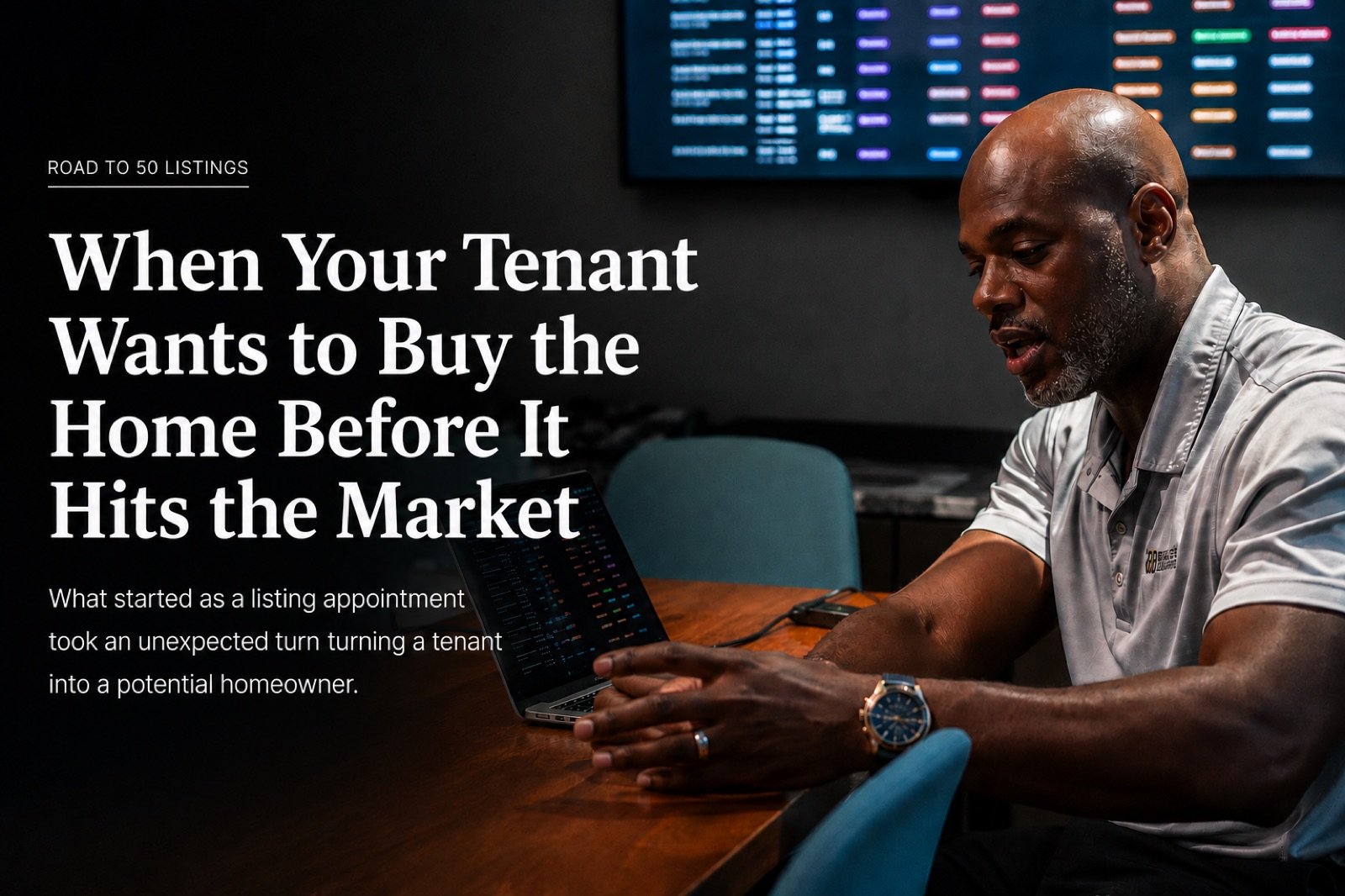
    When Your Tenant Wants to Buy the Home Before It Hits the Market

    Road to 50 Listings | Episode 3

    What started as a routine listing appointment quickly turned into something I wasn’t expecting.

    My seller signed the listing agreement, and the plan was straightforward. Walk the property, prepare it for the market, schedule professional photography, and get it listed.

    Then the tenant shared something that changed the direction of the entire transaction.

    She didn’t want to move.

    She wanted to buy the home.

    As a Realtor, that’s one of those moments where you have to slow down and ask yourself a different question. Instead of focusing only on getting the property listed, how can I create the best outcome for everyone involved?

    For my seller, that still means getting the property sold.

    For the tenant, it means giving her an opportunity to become a homeowner.

    The First Conversation

    Before I even walked the property, the tenant asked if she could speak with the owner.

    The owner preferred to keep communication through representation, which is exactly why having professionals involved matters. It keeps everyone on the same page and allows conversations to stay focused on solutions instead of emotions.

    Once we connected, I visited the property.

    It was immediately obvious that she had taken pride in where she lived. The home was well maintained, and as we talked, she shared why buying this house mattered so much.

    She has lived there for years.

    Her children have grown up there.

    She has invested time, effort, and care into making it feel like home.

    She wasn’t simply trying to avoid moving. She wanted to build a future where she already was.

    Building a Plan

    At that point, the transaction became more than a listing.

    We still moved forward with preparing the property. I scheduled a lawn service to freshen up the exterior, arranged professional photography, and continued preparing the home to go on the market if needed.

    At the same time, we began mapping out what homeownership would look like for the tenant.

    We scheduled a buyer consultation.

    During that meeting, we walked through the home buying process together, discussed financing, answered questions, and signed a Buyer Representation Agreement.

    The next step is obtaining a mortgage preapproval.

    There’s a possibility that her mother may co-sign, and we’ll work through that as we continue moving forward.

    Why This Transaction Stands Out

    Every transaction has its own challenges.

    Sometimes the best solution isn’t the one you expected when you first received the phone call.

    If the tenant qualifies, my seller could sell directly to someone who already loves and cares for the property.

    The tenant has an opportunity to become a homeowner without leaving the place she’s called home for years.

    That isn’t guaranteed yet, but it’s a path worth exploring.

    What Happens Next?

    Right now, we’re waiting on financing.

    If everything comes together, this could become a win for both my seller and the future buyer.

    If not, the property is still fully prepared to move forward as a traditional listing.

    Either way, I’ll continue documenting the process.

    That’s what Road to 50 Listings is all about.

    Not just celebrating closings, but sharing the conversations, decisions, and unexpected turns that happen along the way.

    Follow the Journey

    This story is part of my Road to 50 Listings series, where I’m documenting the real work behind building a listing-focused real estate business in St. Louis.

    If you’re thinking about selling your home, buying your first property, or you’re simply interested in seeing how real transactions unfold, I’d love to have you follow along.

    Watch Episode 3 on YouTube and check back next week to see where this transaction goes next.

  • How Realtors Can Find Off Market Seller Leads

    How Realtors Can Find Off Market Seller Leads

    How One Neighborhood Search Led to Two Seller Conversations

    Most agents think they need hundreds of leads………I don’t.

    I’d rather have a small list of the right property owners than a massive list of people who have no interest in selling.

    A few days ago, one of our agents at Williams-Claytor Realty accepted a contract on a home in Bellefontaine Neighbors.

    Instead of moving on to the next task, I asked myself a simple question.

    Who else in this neighborhood might be thinking about selling?

    Start with a neighborhood, not a ZIP code

    One mistake I see agents make is searching an entire ZIP code…..That’s too broad.

    I opened PropWire and drew a custom boundary around the neighborhood surrounding our listing.

    From there, I filtered for absentee owners who had owned their properties for several years.

    Those owners already had something in common.

    They owned investment property in a neighborhood where we had just demonstrated we could successfully market and sell a home.

    That made the conversation much more relevant.

    Data only works if you use it

    After building the list, I used PropWire’s skip tracing feature to find contact information.

    Next, I imported the list into BatchDialer.

    Every morning, I block time for outbound prospecting before I do anything else.

    That’s where the real work happens.

    The goal wasn’t to pressure anyone into selling.

    The goal was simply to start conversations.

    Some owners told me they weren’t interested.

    Others were curious about what their properties might be worth.

    That’s a win.

    Give people something valuable

    Two owners asked about the value of their properties.

    Instead of emailing a CMA and hoping for the best, I wanted to make the experience more personal.

    I recorded a Loom video for each homeowner.

    Inside the video, I walked through:

    • Active listings

    • Pending sales

    • Recently sold homes

    • How each one affected the value of their property

    Anyone can email a CMA.

    Very few agents take five extra minutes to explain what the numbers actually mean.

    That simple step helped establish trust.

    It also gave the homeowners a chance to see who I was.

    With so many spam calls and scams today, putting a face to the name matters.

    Relationships usually take more than one phone call

    One owner was willing to talk during our first conversation.

    The other wasn’t.

    He was cautious.

    Honestly, I expected that.

    Absentee owners receive plenty of calls from investors, wholesalers, and agents.

    Instead of trying to force the conversation, I stayed consistent.

    I followed up.

    Answered questions.

    Provided value.

    Eventually, he agreed to meet in person.

    The other owner even asked me to prepare another market analysis on a different property.

    That’s another opportunity that started with one phone call.

    The lesson

    People often ask me where I find seller leads.

    The answer isn’t complicated.

    Start with good data.

    Call consistently.

    Provide value before asking for business.

    Follow up.

    That’s exactly what happened here.

    Nothing is guaranteed yet.

    Neither property is listed.

    But the conversations are happening because the work happened first.

    That’s how listing businesses are built.

    One neighborhood.

    One phone call.

    One relationship at a time.

  • Overcoming the Nightmare: Battling Squatters and Reclaiming Our Property

    Overcoming the Nightmare: Battling Squatters and Reclaiming Our Property

    Dealing with squatters can be a landlord’s worst nightmare, especially when they’re savvy enough to create a fake lease to back their illegal intrusion. In our recent experience, we found ourselves facing this exact scenario for the first time. This ordeal not only tested our patience and resilience but also highlighted the need for collaboration with the community and local authorities to protect our property and future tenants.

    The Unwelcome Surprise:

    Our first encounter with the squatters was a shock. They claimed to have been scammed, alleging that they paid a substantial sum to an unknown party for a legitimate lease. Despite their victim narrative, it became evident that they were intentionally targeting our property listings. The situation became urgent when we had a genuine tenant waiting to move in, and the squatters refused to vacate.

    Law Enforcement Roadblock:

    To resolve the issue promptly, we sought assistance from law enforcement. However, our initial attempts were met with frustration. The officers were reluctant to get involved, refusing to approach the property or take immediate action. Frustrated but undeterred, we knew we had to find alternative solutions.

    Forging Alliances:

    Recognizing the uphill battle, we decided to build alliances. Engaging with neighbors and county officials became our next strategic move. By sharing our predicament, we discovered that the squatters had become a nuisance not only to us but to the entire community. The neighbors were equally fed up and willing to collaborate to reclaim our property.

    Community Support:

    The power of community support cannot be overstated. United against the squatters, our neighbors rallied behind us, sharing information and experiences. This sense of solidarity extended to county officials who acknowledged the gravity of the situation. Their support was instrumental in creating a unified front against the squatters.

    Pressuring the Squatters:

    With newfound allies and support, we turned the pressure on the squatters. As we kept pushing and demonstrating the united front against them, the squatters began to feel the heat. The combination of community pressure and involvement of local authorities proved to be more effective than law enforcement alone.

    Victory Without Eviction:

    In an unexpected turn of events, the squatters chose to vacate the property voluntarily. The pressure exerted by us, the community, and the county officials became too much for them to withstand. Our victory came without the need for a lengthy and costly eviction process, allowing us to quickly regain possession and proceed with our plans for the legitimate tenant.

    Conclusion:

    Our experience with squatters taught us valuable lessons about resilience, community engagement, and the importance of seeking alternative solutions when traditional avenues fail. By forging alliances with neighbors and leveraging the support of local authorities, we were able to turn the tide in our favor. This ordeal underscored the significance of collaboration in overcoming challenges that extend beyond the boundaries of a single property. As we move forward, we remain vigilant, prepared, and better equipped to handle any unforeseen challenges that may come our way.